The Gentry Links Trilogy


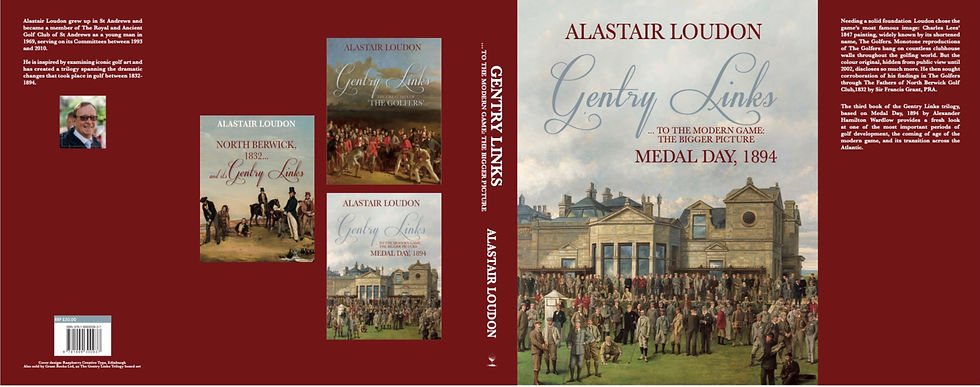
Three paintings. Three illustrated books. Three defining moments in the evolution of golf.
Available as a collector's boxed set, published by Grant Books Ltd — £150 plus postage.
The first work of iconic art examined is the most famous painting in golf, yet one that remained in private ownership for more than 150 years: Charles Lees' The Golfers: The Grand Match Played over the Links of St Andrews on the Day of the Annual Meeting of the Royal and Ancient Golf Club, 1847.
The opportunity to examine the original painting, in all its splendid colours, rather than the monochrome engravings familiar on clubhouse walls around the world, prompted a reassessment of long-held assumptions. The original painting is now in public ownership, in the care of the National Galleries of Scotland.
It also belongs to a moment of impending change. The introduction of the gutta-percha ball reduced the cost of play and increased durability, opening the way to greater accessibility and wider geographical reach.
For my second book, I reached back to an earlier painting that offered a new perspective on The Golfers. That work is Sir Francis Grant's The First Meeting of North Berwick Golf Club, 1832, originally known as The Fathers of North Berwick Golf Club. The original painting hangs in The Links Club of New York.
It records the formation of this East Lothian club within the social world of the Scottish gentry, at a time when the meaning of 'gentleman' itself was beginning to evolve.
The figures at North Berwick represent more than the founders of a single club. Their family, professional and social ties reveal the networks through which golf spread, notably with two of its Captains, to Prestwick and the first Open Championship in 1860.
The third painting moves the story forward almost half a century. Alexander Hamilton Wardlow's Captain Driving Off, more commonly known as Medal Day at St Andrews, 1894, is a vast collective portrait of 191 figures, metaphorically signalling the expansion of the game. The original painting hangs in the Big Room of the R&A.
At its centre, Old Tom Morris tees the ball for the incoming Captain of The Royal and Ancient Golf Club, the Right Honourable Arthur James Balfour. Around them stand champion golfers, Captains and officeholders, including men who would later serve on the first Rules of Golf Committee in 1897. Many of these have significant international connections, particularly some that would result in the game developing in Canada, and then America.
By 1894, the modern game, whose expansion had been facilitated by the economic changes brought about by the gutta-percha ball, was coming of age.
As golf spread, the need for a common code of Rules became increasingly apparent. At the request of leading golf clubs in Great Britain, the R&A assumed a wider responsibility for the game, establishing its first Rules of Golf Committee in 1897.
Together, these three paintings provide the historical biographical content for The Gentry Links Trilogy, revealing how the people, relationships and institutions of nineteenth-century Scotland laid the foundations of the modern game.

NOT CURRENTLY FOR SALE AS INDIVIDUAL TITLES
ADDENDUM — THE FINISHED SKETCH REAPPEARS
An important development in the history of Charles Lees' The Golfers.
The reappearance at Sotheby's in February 2026 of Charles Lees' Finished Sketch is a significant development in the history of one of golf's most celebrated paintings. For many years it had also been held privately, and, like the finished painting, not available for public scrutiny.
The importance of the Finished Sketch, particularly the evidence provided by Lees’ changes in colour allocation, developing composition and character alignment, was examined in detail in the first two volumes of The Gentry Links Trilogy.
That research challenged the traditional interpretation of The Golfers, that had been unchallenged since the release of the monotone engraving over 150 years previously, advancing the proposition that Lees depicted a Grand Match between St Andrews and North Berwick.
The sketch's reappearance, and the unsuccessful attempt by the R&A World Golf Museum to acquire it, bring renewed attention to the importance of this surviving evidence and to the historical interpretation already advanced in the Trilogy.
